
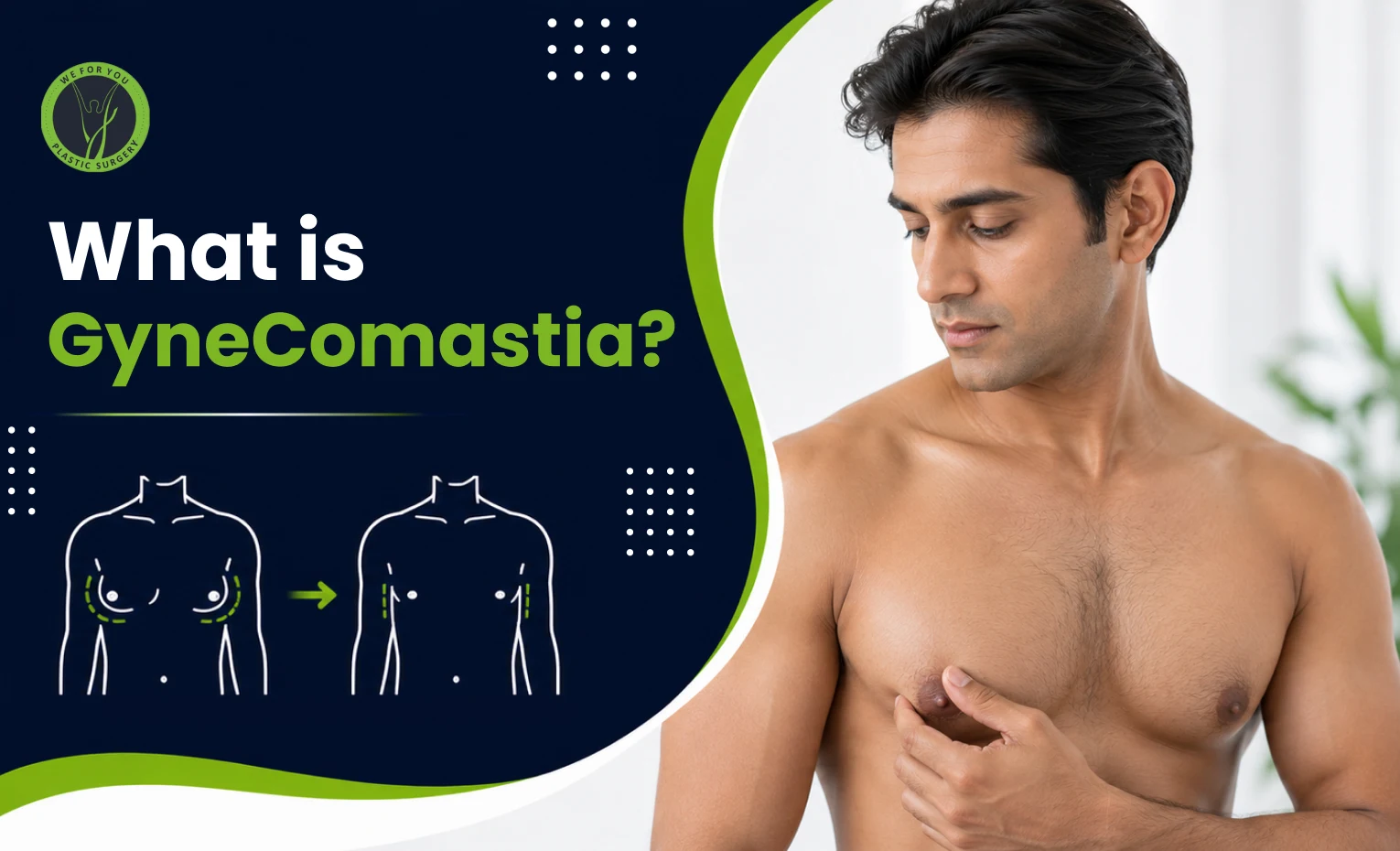
Gynecomastia is the enlargement of glandular breast tissue in males caused by a hormonal imbalance between estrogen and testosterone, and it affects men of all ages regardless of weight or fitness level.
Most men living with it spend years believing it is just fat that will go once they train harder. It will not. If the tissue feels firm and rubbery behind the nipple, no exercise will remove it because it is glandular tissue, not fat. This blog covers causes, grades, surgery, and what to honestly expect from gynecomastia surgery in Gurgaon at WFY Plastic Surgery Centre.
What Gynecomastia Actually Is
Your body, male or female, has breast tissue. In males, testosterone keeps it suppressed. When that balance tips, even slightly, estrogen takes over and glandular tissue begins to grow.
This is gynecomastia. Actual breast gland tissue developing in a male chest.
Q: Can I tell at home if I have gynecomastia or just chest fat?
Press gently around the nipple. If you feel a firm, disc-like lump beneath it, that is glandular tissue. Pure fat feels soft and diffuse throughout the chest.
Q: Does gynecomastia go away on its own?
In teenage boys, it often resolves within two years as hormones stabilise. In adult men, if it has been present for more than twelve months, the tissue becomes fibrous and will not reverse without surgery.
Also Read: What Is Facelift Surgery?
Types and Grades: Why the Difference Matters
Not all gynecomastia is the same. Understanding the type determines the treatment.
True Gynecomastia. Firm glandular tissue behind the nipple. Caused by hormonal imbalance. Cannot be removed by liposuction alone. Requires gland excision.
Pseudogynecomastia. Soft breast enlargement caused entirely by fat. Common in men who are overweight. Responds to liposuction or weight loss.
Mixed Gynecomastia. A combination of glandular tissue and fat. The most common presentation seen in adult men. Requires both liposuction and gland excision together.
Surgeons also classify gynecomastia into four grades based on severity. Grade 1 is mild puffiness around the nipple. Grade 4 involves significant tissue overhang with excess skin and drooping. The grade directly determines the surgical technique used.
Q: What is the most common grade treated at plastic surgery centres?
Grades 2 and 3 are the most frequently seen cases, involving visible chest enlargement with or without mild skin laxity.
Q: Is pseudogynecomastia easier to treat?
Yes. Since it involves only fat, liposuction alone is usually sufficient and recovery is faster.
Why It Happens
The root cause is a hormonal imbalance. But the triggers vary.
Puberty is the most common cause in young men. Ageing is the most common cause in older men, as testosterone levels naturally decline. Certain medications, including those for blood pressure, depression, and prostate conditions, can trigger it as a side effect. Anabolic steroids and marijuana use are also known contributors.
Body causes this. Not weakness.
The psychological weight is real too. Avoidance of physical intimacy. Social withdrawal. Loss of confidence in professional settings. These are consistent patterns in men living with this condition and they matter as much as the physical correction.
Q: Should I get my hormones tested before surgery?
Yes. A responsible surgeon will always check hormone levels before recommending surgery to rule out an underlying treatable cause.
Q: Can stopping a medication reverse gynecomastia?
If the tissue is recent (less than twelve months), yes, in some cases. If it has been present longer, surgery is usually the only effective option.
Also Read:- What Is Rhinoplasty Surgery?
Diagnosis and Consultation: This Is Where Things Go Wrong
This is the part most people overlook. The results of gynecomastia surgery in Gurgaon depend far less on the surgery itself and far more on the assessment done beforehand.
What goes wrong? A surgeon who does not distinguish between true and pseudogynecomastia recommends liposuction alone. The fat is removed. The glandular tissue remains. The chest still looks enlarged. The patient feels let down. That is not a surgical complication. That is a planning failure.
At WFY Plastic Surgery Centre in Gurgaon, a proper consultation means identifying the exact tissue composition, grading the condition correctly, assessing skin quality, and selecting the right technique before any procedure is discussed. If this assessment is not happening, the outcome is already uncertain.
Procedure, Recovery, and Honest Risks
Surgery takes one to two hours. Local anaesthesia is used for mild cases. General anaesthesia is used for grades 3 and 4. Most patients go home the same day.
Liposuction removes excess fat through very small side-chest incisions. Glandular tissue is excised through a small incision along the areola border where it heals discreetly. A compression garment is worn for four to six weeks.
Light activity resumes within two weeks. Gym and physical training restart around six weeks. Final chest contour settles around three to six months.
Honest risks. Temporary swelling, bruising, and numbness are expected and resolve. Asymmetrical healing in the early weeks is common and not a surgical error. Contour irregularity is rare with experienced hands. Recurrence is possible if underlying hormonal causes are not addressed.
Frequently Asked Questions
Is the surgery painful?
Discomfort is mild to moderate for the first two to three days. Patients describe it as tightness and soreness. Medication manages it well.
Will there be visible scars?
This is the question every patient has, and it deserves a direct answer.
Liposuction incisions are tiny (3 to 4mm), placed at the side of the chest, and practically invisible within months. Gland excision incisions follow the natural curved edge of the areola.
Week one: the incision line is red and healing.
Month three: it has faded to a pale line and is not visible through clothing.
Month twelve to eighteen: for most patients, the scar is imperceptible in normal light.
The trade-off for that small, well-placed mark is a permanently flat, masculine chest. That is worth understanding clearly before you decide.
What does gynecomastia surgery cost in Gurgaon?
Cost depends on grade, technique, and whether liposuction is combined with excision. At WFY Plastic Surgery Centre, a fully itemised cost breakdown is given during consultation. You will know the complete figure before committing to anything.
Can it come back after surgery?
Surgically removed glandular tissue does not regrow. However, if the hormonal trigger continues unchecked, new tissue formation is possible. This is why addressing root causes alongside surgery is important.
Is this cosmetic or medical?
Both. Cosmetically, it restores a masculine chest contour. Medically, it can relieve the chronic tenderness many men experience in the affected tissue. It is a legitimate and well-established procedure.
Why WFY Plastic Surgery Centre, Gurgaon
Here is what that looks like in practice at WFY Plastic Surgery Centre in Gurgaon:
- Every case of gynecomastia surgery in Gurgaon begins with a detailed tissue composition assessment, not a standard treatment package
- True, pseudo, and mixed gynecomastia are each approached with the technique that fits them specifically
- Surgical planning accounts for grade, skin laxity, and long-term chest contour, not just immediate tissue removal
- Cost is explained in full at consultation with no hidden additions afterward
- Follow-up care is built into the process from day one
Men who have completed the process consistently say the same thing. Not that their chest looks different. That they finally stopped thinking about it.
Decide.
You have been managing around this condition long enough. Choosing what to wear. Avoiding certain situations. Carrying something that is entirely fixable.
Book a consultation at WFY Plastic Surgery Centre. Ask every question you have. Leave with clear answers and a real plan.
One conversation. The right information. Then the decision is yours.